Birdwatching
Best binocular magnification for bird watching: 8x or 10x?
8x or 10x for birdwatching? How magnification changes field of view, brightness and shake, and which suits woodland, gardens, estuaries and hills.
Ask ten birdwatchers what magnification to buy and most will answer 8x or 10x. The RSPB puts it in one line: 8x or 10x magnification is the best compromise between power and practicality in birdwatching binoculars. Which of the two suits you depends on where you watch birds, how much light there is and how steady your hands are.
The short answer
- Choose 8x if you mostly watch gardens, parks, hedgerows and woodland, if you often go out at dawn and dusk, or if you are new to binoculars.
- Choose 10x if you spend most of your time at estuaries, reservoirs, on the coast or on open hills and moors, where birds are further away.
- Consider 12x only as a second pair for long views, and plan to lean on something or use a tripod.
The RSPB gives the same split: 10x for open country and large stretches of water, 8x for woodland, close-range viewing and poorer light.
What changes when you add magnification
Going from 8x to 10x makes a bird look a quarter closer. That extra reach is easy to see on a distant wader. What is less obvious in the shop is what you give up.
A narrower field of view
The field of view is the width of the scene you see. It nearly always shrinks as magnification rises. A typical 8x42 shows a little more than a 10x42, and a 12x50 shows less again. Our 12x50 is listed at 88 m at 1,000 m, which is 5 degrees.
A wide field makes it easier to find a bird that has just flown into a tree and to follow a flock in flight. The National Audubon Society in the United States suggests that birding binoculars should have an angle of view of at least 6.5 degrees, about 114 m at 1,000 m. Not every good pair meets that, but it is a useful benchmark.
More visible shake
Binoculars magnify the small, constant movements of your hands just as they magnify the bird. At 10x the image moves a quarter more than at 8x. Most adults manage 10x well. At 12x many people find the image tiring to watch for more than a few seconds without support. Your brain works harder to read a shaky image, and fine details such as wing bars and eye rings are harder to pick out.
A dimmer view in poor light
With the same objective lens, higher magnification means a smaller exit pupil. An 8x42 has an exit pupil of 5.25 mm, a 10x42 4.2 mm. In daylight both look equally bright, because your own pupil is only about 3 mm wide. In a dark wood, at dawn or at dusk, the 8x42 keeps more of its brightness. That is one reason owl and nightjar watchers often prefer 8x or a larger objective lens. What the numbers on binoculars mean explains exit pupil in more detail.
Less depth of field
Higher magnification also means a thinner zone of sharp focus. With 10x or 12x you turn the focus wheel more often when a bird moves from the front of a bush to the back. With 8x more of the scene stays sharp at once.
Which magnification for which habitat
| Where you watch | Typical distance | Suggested magnification |
|---|---|---|
| Garden and feeders | 3 to 20 m | 8x, with close focus |
| Woodland and hedgerows | 5 to 50 m | 8x |
| Parks, lakes and rivers | 20 to 150 m | 8x or 10x |
| Estuaries and reservoirs | 100 m and more | 10x, or 12x with support |
| Coast and seawatching | 200 m and more | 10x, or 12x with support |
| Moors, hills and raptors | 100 m and more | 10x |
| Dawn, dusk and owls | varies | 8x42 or larger lenses |
Objective size: 32 or 42 mm?
The second number matters too. 8x32 binoculars are lighter and smaller than 8x42 and give an exit pupil of 4 mm, which is fine for most daylight birding. 8x42 and 10x42 are the most common full-size choices because the 42 mm lenses keep the view bright into the evening without making the binoculars too heavy to carry all day. An RSPB blog notes that most models in the RSPB range are 8x32, 8x42 or 10x42.
If weight is your main concern, look at compact binoculars as a second pair, and read Compact vs full-size binoculars before you choose.
Close focus for garden birds and insects
If you watch a feeder a few metres from the window, or you enjoy butterflies and dragonflies on summer walks, check the close focus figure. The RSPB points out that close focus becomes important for insects, small mammals, reptiles and plants. A close focus of about 2 to 3 metres covers most of these. Our 12x50 focuses down to 2.5 m.
Glasses and eye relief
If you wear glasses, check the eye relief. Birding binoculars typically offer around 15 to 20 mm. Eye relief above about 16 mm is generally enough with glasses, provided the eyecups twist or fold down. Set them down when you wear glasses and up when you do not. Our 8x42 is listed at 18 mm and the 12x50 at 16 mm.
How to hold binoculars steady
Whatever you choose, technique makes a big difference:
- Tuck your elbows in against your chest rather than holding your arms out.
- Rest your thumbs under the barrels and your fingers on top, close to the eyepieces.
- Lean on something: a tree, a fence post, a gate, a hide window ledge or a car roof.
- Breathe out slowly while you study a detail, as photographers do.
- Shorten the strap so the binoculars hang high on your chest and come up to your eyes quickly.
With these habits most people can use 10x comfortably, and short looks at 12x become possible.
Setting up new binoculars
Before your first walk, set the hinge so you see one round image. Close your right eye and focus on a sign or a branch about 20 metres away with the central wheel. Then close your left eye and adjust the dioptre ring on the right eyepiece until the image is sharp. Note the dioptre setting. From then on you only use the central wheel.
Our binoculars for birdwatching
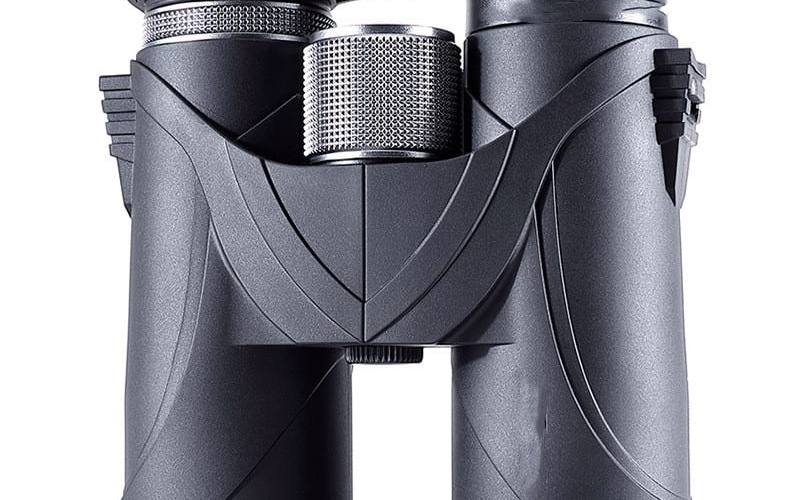
- 8x42 roof prism binoculars: the all-rounder for gardens, woods and walks, with a 5.25 mm exit pupil.
- 10x42 roof prism binoculars: more reach for water and open country, field of view 102 m at 1,000 m.
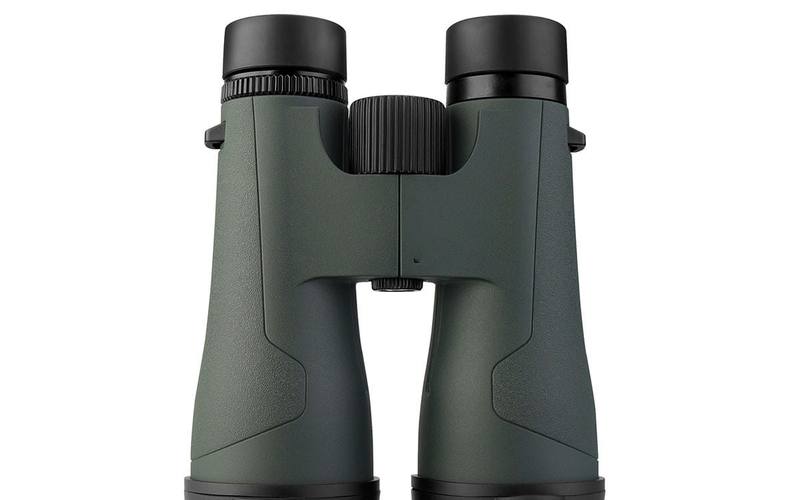
- 12x50 waterproof binoculars: IPX7 rated, BaK-4 prisms and a tripod adapter thread for long sessions.
If you are still unsure, choose 8x. A pair that shows a slightly smaller bird but finds it quickly and holds it steady gets used more than one that shows more detail you cannot keep in view.
Frequently asked questions
Is 8x or 10x better for bird watching?
Both are good, and most birdwatchers use one of the two. 8x is easier in woodland, gardens and poor light because the view is wider, steadier and brighter. 10x shows more detail over water and open country. If you mostly watch at close and medium range, start with 8x.
Are 12x binoculars good for birdwatching?
They are useful for distant birds on estuaries, reservoirs and the sea, but the narrow field and the extra shake make them hard work for small birds in trees. Most people use 12x with something to lean on or a tripod.
What size binoculars does the RSPB recommend?
The RSPB describes 8x or 10x magnification as the best compromise between power and practicality for birdwatching, and suggests 10x for open country and large stretches of water and 8x for woodland, close range and poorer light.
What field of view do I need for birding?
Wider is easier. The National Audubon Society in the United States suggests an angle of view of at least 6.5 degrees for birding binoculars, which is about 114 m at 1,000 m.
Do I need close focus for birdwatching?
It helps if you watch garden feeders, butterflies or dragonflies. A close focus of about 2 to 3 metres lets you see subjects that are almost at your feet.